Memories of my grandfather

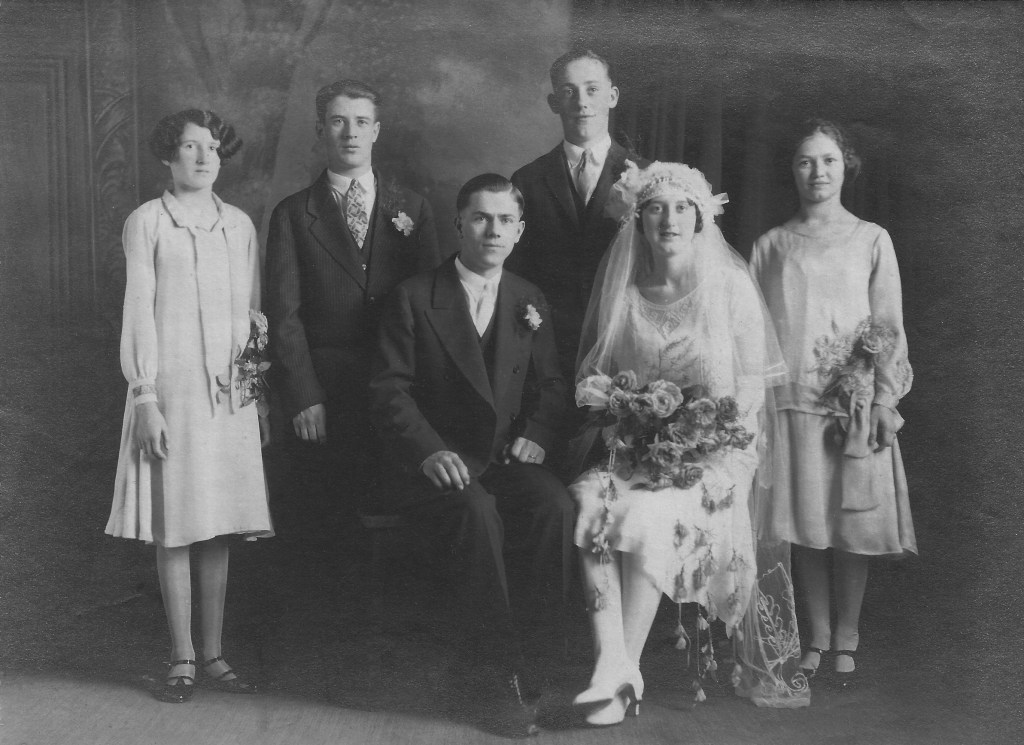
I’m thinking about my grandparents lately. Here’s what I remember the most about my grandfather Alex Kaiser. He could mash potatoes so smoothly with just a metal potato masher and the strength of one arm, you would swear the potatoes were whipped. He used to bet his grandchildren they would never be able to find a lump when he finished mashing them, and he was right. Those potatoes were lump-free, creamy goodness topped with real butter and a dash of salt.

He and my grandmother used to have a party line phone, where they shared a phone line with another family. And get this: The phone company billed them for incoming, local calls, but his work line calls were billed differently. So they had a system worked out where if he needed to call home from work, he would let the phone ring twice and then hang up. My grandmother, or my Nana, as we fondly called her, would then know to call him back. Free call. They were sneaky.

He always used to drive a Buick, the best car in the world, he used to say. Every winter they would leave Wisconsin and drive out to California in a red Buick. My sister and I would wait out in the front yard for them, patiently looking for that red Buick to turn into our driveway. Until that year when a dark blue Pontiac pulled up to the house instead. That was the year that he discovered Buicks were not the only good cars on the road. That Pontiac never gave him one problem, and he loved it so much that he said he would never go back to a Buick again.

As a grandfather, Alex was always concerned about his grandchildren wearing shoes that were made properly and fit well, thanks to a career as a shoe salesman. It must have come as a shock to him when one of his granddaughters — me — had one of the widest foot sizes ever recorded for a child. I remember when he visited us, how he would take me out to shoe store after shoe store, trying to find shoes to properly fit my wide feet. He would hold his chin between his thumb and index finger and shake his head back and forth every time a pair of shoes didn’t fit me. Which was often. Although he’s no longer with us, nothing about my feet has changed.

I would be a decade older before I learned that my grandfather had more than smooth potatoes, cool cars, shoe wisdom, and phone hacks to talk about, but I’ll save that for another post.

Ockham’s razor

The 14th century philosopher and theologian William Ockham posed the now famous theory that, and I’m paraphrasing here, the simplest answer is probably the correct answer. This theory can also apply to those conducting genealogy research: if you are jumping through hoops trying to force a relationship between people, it probably isn’t there. Minimally, you are trying to establish a connection the wrong way.

This happens most frequently when people are trying to prove a connection to pilgrims, Mayflower descendants, presidents, people born before the year 1000 A.D., or royalty. I understand the need to feel connected to people and events that happened long ago in history, but folks, you are alive today. Isn’t that connection enough? Your family members are survivors who withstood barbaric practices, medieval torture, plagues, massacres, the guillotine, sailing into uncharted territories, the great depression, and the COVID-19 pandemic.

If you still feel compelled to call a famous person or historical figure Grandma or Pop Pop, use the theory of Ockham’s razor to help you focus on real connections. If you are working to find a long lost, previously unknown child that George Washington may have had with an undisclosed mistress, you are probably on a mission that won’t end well.

Prove what you can. Follow the lines of those in your family who came before you, wherever that journey may lead. Be surprised. Focus on giving previously unknown ancestors the attention they deserve. Find your own personal heroes. After all, these people are the reason you are alive today.

Paper genealogy

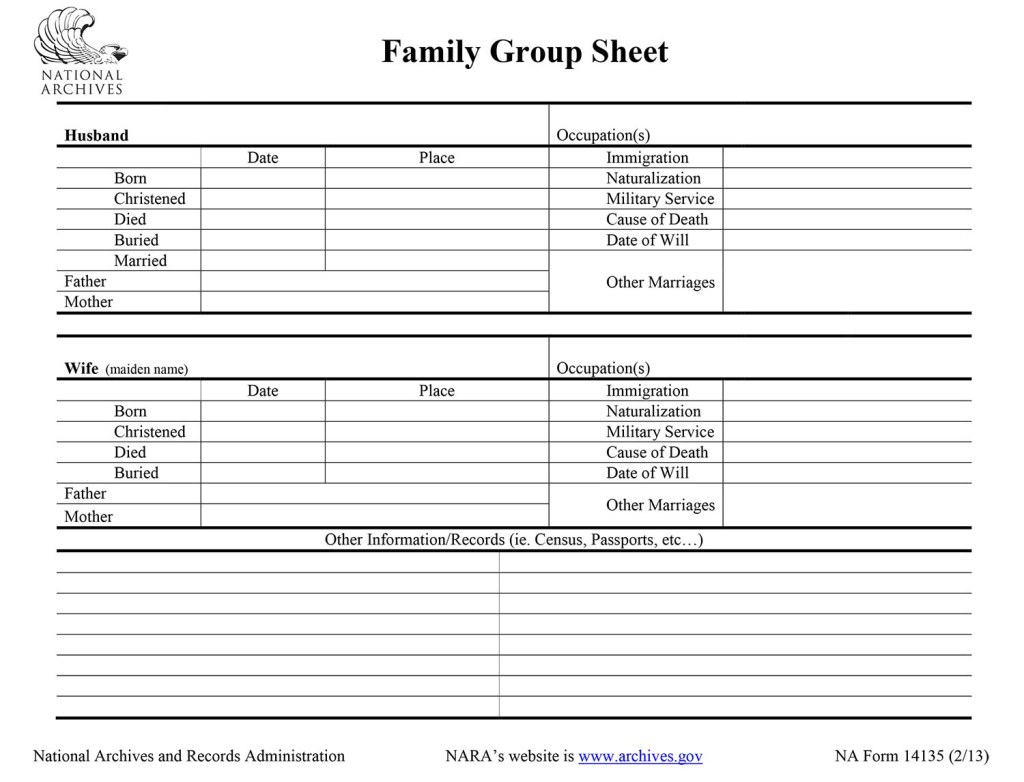
Are you a paper genealogist? Check out Archives.gov for their great selection of pedigree charts and other genealogy forms. I prefer their forms because they are neat and clean and have a lot of white space. You can see all their forms here:

https://www.archives.gov/research/genealogy/charts-forms

Here are some of my favorite forms.

Ancestral chart – blank form
National Archives genealogy worksheet
Genealogy

These forms have all been reduced in size and dpi (dots per inch) to make them easier to post here. If you’d like to use them, go to the link above and download the full-sized forms from the National Archives website.

Land patents

Do you have ancestors who homesteaded land as they made their way west across the country? You can track down those documents on the Bureau of Land Management website. You need to input the name of your ancestor and the location of the land (the state is fine). Your search will reveal the land patent details, patent document, and related documents. Check it out here:

https://bit.ly/2VuBYjy.

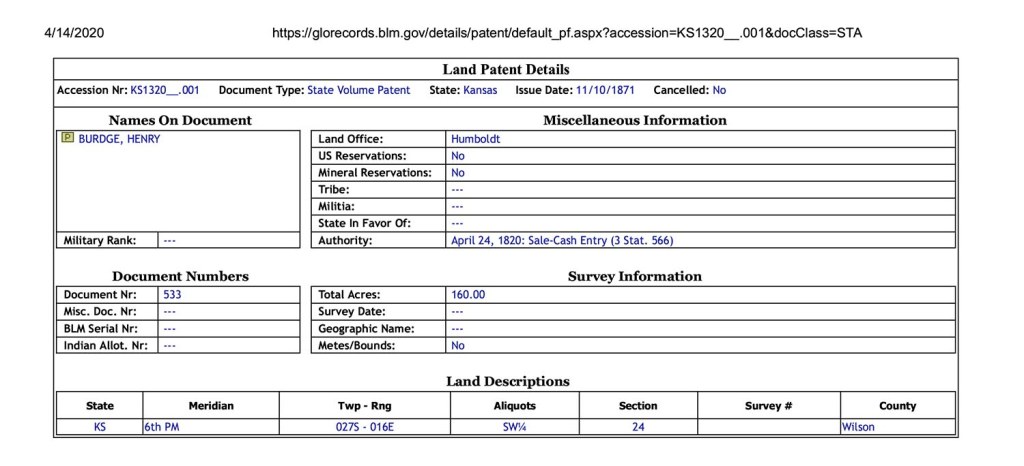
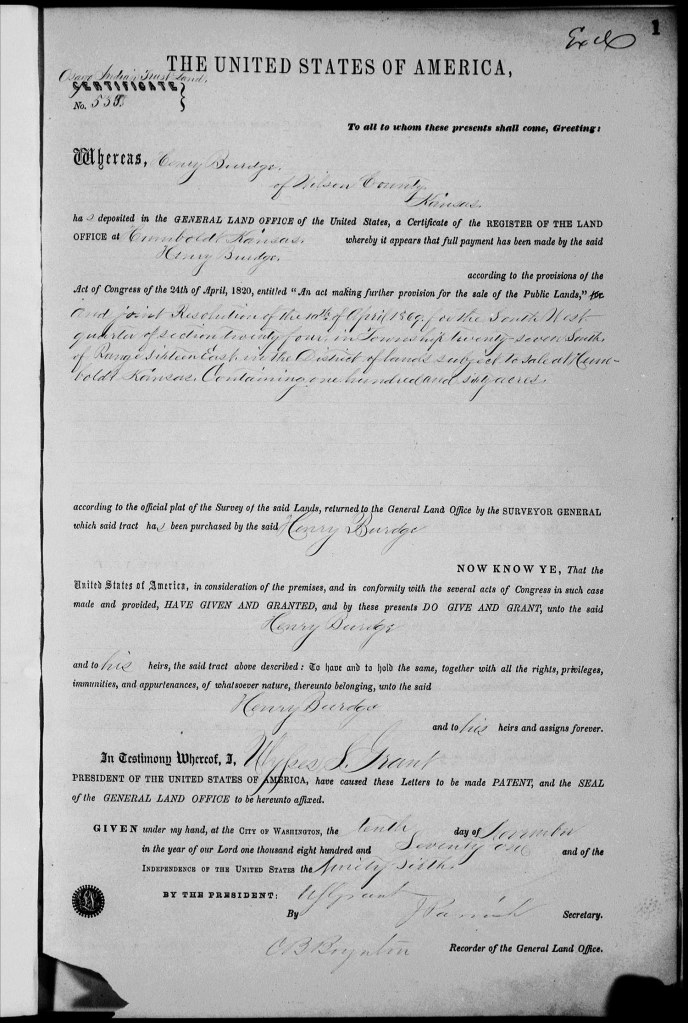
Here’s an example from my research. My second great grandfather was a man named Henry Burdge, from Somerset, England. He immigrated to the United States and homesteaded land in Kansas. I never knew the exact location of the original property until I searched for the record on the Bureau of Land Management’s website. Here are the documents that appeared for Henry Burdge:

These pages show me exactly how much land he obtained and the exact location. The last document shows other nearby or adjoining property owners. This information confirms oral family history that said Henry Burdge was the first non-Native American settler in the area. It would be eight years before he could convince a woman to follow him there to live in a very special mud hut. Before larger towns developed, Henry called this area Burdgeville, of which he was named the postmaster. It is a few miles northwest of Colfax township. The post office was moved to Colfax in 1888 and what was left of Henry’s little town disappeared, but now I know where it all started.

Special characters

Are there special characters in your ancestors’ names? Accents, umlauts, or cedillas? Francois just isn’t the same thing as François, nor is Loffler the same as Löffler or Hanss the same as Hanß. Without a keyboard in a language other than English, you can still easily get these special letters using the Alt key and a special four-digit numerical code. For example, an e with an accent mark – é – can be made by pressing down the Alt key on the left side of the space bar on your keyboard and typing the numbers 0233. Usefulshortcuts.com has a great list of alternative letters and the codes, or alt codes, used to create them. Here’s the link: https://bit.ly/2VuJ6fz.

Extra letter codes like æ, ø, and å can be found here: https://bit.ly/2RDfbRz.

To spit or not to spit

If you are late to the DNA train, please consider being tested. True story: My husband discovered an adult daughter he never knew he had. And grown grandchildren. It changed our lives for the better.

Even if you don’t have a big reveal like that, you can help some else discover who they are or connect them to unknown family members. It’s one of the greatest gifts you can give someone. Besides being an organ transplant donor. Or giving someone CPR. You get my point.

If you do test, please post at least a small family tree, if allowed, so that other matches can tell how they may be related to you. If someone sends you a note, asking about a possible match, please respond, whether or not you have anything valuable to add to their search. You don’t have to write a novel or do their search work for them. If you don’t have an answer to their question, just say so.

Although it doesn’t really matter which company you test with, that is also conditional upon your main reason for doing the DNA test. If you are looking for answers or lost family members, Ancestry has the largest number of participants. If you are looking for where you came from genetically, which is, frankly, speculation, then you may prefer testing with another company or with multiple companies.

No matter which company you test with, consider uploading your DNA test results to GEDmatch.com. This site allows people who tested on different sites to compare their results and add to their potential matches. The site also has some great tools for helping determine your genetic admixture.

If you are a criminal or have a family member who has committed a serious crime, you may want to think twice about the whole DNA test business since law enforcement is now using DNA to track down offenders. On the other hand, maybe it would be a deterrent to committing a crime if a person knew he or she would eventually be captured because their family members put their DNA on GEDmatch.

Any criminals in my family are doomed to be apprehended sooner or later, since I’ve tested with all the major DNA testing companies and uploaded the results to GEDmatch. As far as I’m concerned, genealogy prevails every time.

Sourcing an old family tree

If you have a family tree that was passed down to you, consider finding sources for each person on the tree. It’s not as difficult as you might think, and we can give you suggestions for making it easier for you.

Start with the earliest people on your pedigree chart and work your way backwards in time. In addition to birth and death records, don’t forget about marriage and census records.

FamilySearch.org is free and has lots of good information available online. This is one of my favorite sources. Plus they create a perfect source that you can cut and paste into your genealogy program. Here’s the exact FamilySearch source provided to me for someone I’m researching:

“United States Census, 1900,” database with images, FamilySearch (https://familysearch.org/ark:/61903/1:1:M3CT-VHB : accessed 13 April 2020), Adwood Taylor, Howell Township (excl. West Plains city), Howell, Missouri, United States; citing enumeration district (ED) 54, sheet 15B, family 294, NARA microfilm publication T623 (Washington, D.C.: National Archives and Records Administration, 1972.); FHL microfilm 1,240,860.

Ancestry.com is another great source of information, but there is a cost. That said, I’ve had an Ancestry account for more than 10 years and I’ve never regretted it for even one moment. Be sure you use it for sources and not to copy unsourced family trees unless you intend to source them yourself. Their source suggestions are confusing and convoluted, so I will copy what I need, but make them look the way I prefer. Here’s how I source an Ancestry.com piece of information:

Missouri Death Certificates. Missouri Secretary of State. Atwood Taylor, died 04 May 1929 in Howell County, Missouri. Ancestry.com. Web: Missouri, Death Certificates, 1910-1962 [database on-line]. Provo, UT, USA: Ancestry.com Operations, Inc., 2015. See: https://ancstry.me/2V4oLin.

Another favorite for me is Findmypast.com. If you have ancestors from the United Kingdom, Ireland, Australia, New Zealand or Canada, this can be a great source. Some of the information can be found in Ancestry and FamilySearch, but it’s not consistent or complete trade off. The only negative is that it can be difficult to match death records if you don’t already have a location or general date for your ancestor. I work around that as best I can. Here’s how I write a source for information found here:

Ireland Roman Catholic Parish Baptisms, Owen Clark, baptized 19 June 1836 in Haggardstown, Armagh, County Louth, Ireland. Via Findmypast.com online database, see: https://bit.ly/2yTnSk6.

If you have found information in a publication that is not available online, then use a traditional, scholarly source, as recommended by all professional genealogy organizations:

“1834 Census of Grimm in the District of Saratov, Russia”, dated 2 February 1835; Translated by Brent Mai, Concordia University, Portland, Oregon; Published by Dynasty Publishing, Beaverton, OR, USA; Published 2011; page 74, family #248, Johann Michael Kaltenberger family.

Or this:

Eichhorn, Dr. Alexander, Dr. Jacob and Mary Eichhorn, The Immigration of German Colonists to Denmark and Their Subsequent Emigration to Russia in the Years 1759-1766; Bonn, Germany and Midland Michigan, USA; Drukerei und Verlag Steinmeier GmbH & Co. Kg, Deiningen, Germany, 2012; page 409, family 427, Jacob Fritzle/Fritzler.

Secret to Sourcing

The most important thing you can do as you research your family history is to keep good records about where you find information. That’s a lot easier to do in the digital age, since you can just copy and paste details and links. My secret weapon is using Bitly.com to shrink the links to manageable sizes. You can add an icon to your desktop. The next time you find an important detail, just click on the orange bitly icon and it will create a nice, neat link. Copy and paste it into your favorite genealogy program.

Here’s a sample: https://bit.ly/34xu6BQ. I usually add the name of the page, the person and identifying details, and the link above. So my official link would look like this:

Grimmrussia.org online database, Danish German Immigrants to Grimm, Russia, 11. Jacob Fritzler, see: https://bit.ly/34xu6BQ.

This source tells you exactly where you found the information, the name of the person it applies to, and a link to the page where the information resides. The goal is for anyone following your research to know exactly how to see your sources for themselves.